Translated into English
By: Luis Johanson
Database Stand-Alone
A database Stand-Alone works only on a computer and the application program directly accesses the database. Only one program at a time can access the database.
An access through a network it is theoretically possible under the restrictions mentioned above. However, this type of database reaches its limits, if the access rule parallel, if the data should be used by several people.
Compared with other types of database, management of the database is simple. So in a database such Stand-Alone disappear costly implementations for the complicated multi-user use and resulting transaction management, which is required when at the same time you want to run in the database, several operations of different users.
There are several examples, though they mostly do not show as a database. For example, in managing a customer contact E-mail or the like, this is a database Stand-alone, because the data are stored locally and only the source program to access them.
Database File-Share
Database File-Share type allowed in contrast to databases Stand-Alone Multi-user operation. For this, the database file is located on a central server. For queries are completely transmitted to the computer database client. Once in the computer Client, proceed to the handling of data. The server serves here only as a distributor, which is making the database file to another computer.
problems appear extremely high load on the network, as not only necessary data is transmitted, but the entire database, in which just once in the side Customer can execute the necessary operations.
While only access the database to read, this problem can be avoided in part with a network structure powerful enough.
The main problem is in editing or changing data. Since the data are published in the client and then as a complete whole is forwarded to the server, there are insufficient opportunities to verify the integrity of the database, searchable, and undo changes to the database if necessary.
Examples of such Database File-Share are: Microsoft Office Access and Pendant OpenOffice Base.
Database Client-Server
For this type of database, you have a central computer as database server. This database server are both data base data and the management system database (DBMS).
this server accessed by client programs running on computers other than the DBMS, through the network. The rationale for this type of database is standardized in 1992 with the ISO 9579 standard .
Since for this type of database you are always working with a database file on the server side and transmitting only the information necessary to the customer, comes off the main disadvantages of the previous model.
So one hand is a network load child and the other side can verify the integrity of the database immediately.
Since all customer transactions are sent directly to the DBMS, and once there are processed centrally, immediately possible to verify the integrity of the changes. Moreover, any change in the database is immediately available to other customers.
Database Model
The base for structuring data and relations between them is the Model Database, which is set by the manufacturer of the DBMS. According to each model, the scheme database must adapt determinades structuring possibilities:
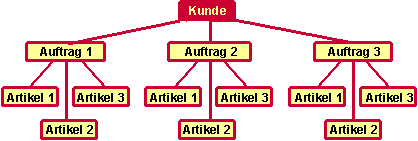
- Hierarchical Database: data objects can be linked only in a Father-Son relationship.
- Network Database: Data objects are connected through a network.

- Base relational database: The data are given by rows in tables. There may be various relationships between data.
- Base object-oriented data: relations between data objects are managed by the same database system. Objects can inherit properties of other data objects.
A variety of combined forms and alternative forms, such as: the model of relational database OOP.
Source: http://www.monta-n.net/portal/Datenbanken_1_Datenbankarten.php


0 comments:
Post a Comment